Loading blog post...
Posted on 29 September 2026
Learning “AI” on its own can feel overwhelming. There are countless tools, courses, and new terms, but it is not always clear how they connect to a job.
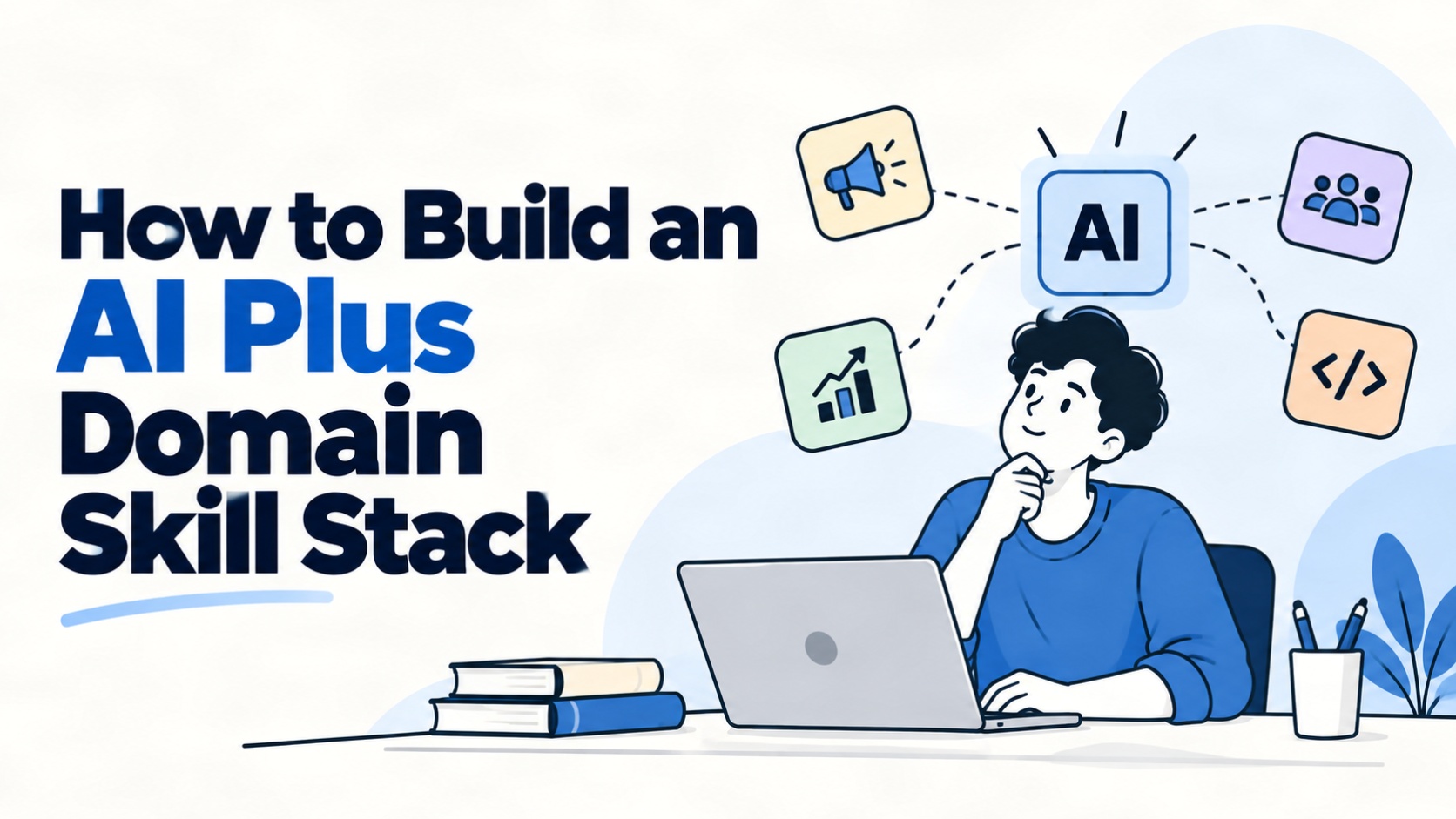
A more useful approach is to combine AI with a field you want to work in. Think of it as an AI plus domain skill stack: you understand the work in a particular field, and you know where AI can help you do that work better.
The goal is not to claim you are an AI expert after trying a few tools. It is to solve a real problem, check the quality of the result, and explain your decisions.
Choose a field that interests you: marketing, finance, HR, or software development. Then look at entry-level job descriptions and identify three tasks that appear often.
For each task, ask:
Those questions give your learning a direction. Without domain knowledge, it is difficult to spot when an AI answer sounds convincing but is wrong.
A marketer needs to understand the audience, the message, and how success will be measured. AI can help brainstorm campaign angles, draft variations, and organise research. It cannot decide whether a claim is accurate or whether the message fits the brand.
Project idea: Choose a small business and create a two-week campaign plan. Define its audience, write three versions of an advertisement, and explain which version you would test first. Document where AI helped and what you changed after reviewing its suggestions.
Finance work depends on accurate data and clear reasoning. AI can help summarise information, explain formulas, or suggest questions to investigate. Every calculation and conclusion still needs verification.
Project idea: Use a sample dataset to build a monthly expense dashboard. Identify two trends, check your calculations, and write a short explanation a non-finance colleague could understand. Never upload private financial information to a tool without permission.
HR involves communication, fairness, privacy, and context. AI can help draft a job description or organise interview questions, but people must review the wording, requirements, and potential bias.
Project idea: Select an entry-level role and prepare a hiring pack: a clear job description, a skills-based interview guide, and a simple evaluation rubric. Explain how your rubric assesses relevant skills consistently.
If you prefer a structured starting point, Persevex courses can help you develop your chosen domain skills before you add an AI project alongside them.
AI can speed up exploration, debugging, and documentation. A developer still needs to understand the requirements, review generated code, test edge cases, and maintain the result.
Project idea: Build a small application that solves one specific problem. Use AI to explore an implementation option, then record what you accepted, changed, or rejected. Include tests and a short explanation of the application's limitations.
Whichever domain you choose, publish a short case study with your project. Show the original problem, your approach, the finished work, and the checks you performed. Be honest about the role AI played.
An interviewer should be able to see what you know about the domain, what you built, and how you judged the AI output. That is more persuasive than listing ten AI tools on a résumé.
Start small: choose one domain, one recurring task, and one project you can finish. A useful skill stack grows from work you can explain and improve—not from collecting tool names.